Can Invisalign Fix Overbite? Everything You Need to Know
June 15, 2026
If you have been told you have an overbite, you are not alone. It’s one of the most common dental alignment issues in the world. And if you are wondering can Invisalign fix overbite problems without metal brackets and wires, the answer is yes. Invisalign can effectively treat mild, moderate, and even certain severe overbite cases using a series of custom clear aligners designed specifically around your bite and tooth structure.
Beyond aesthetics, overbite correction matters for your long-term oral health. An untreated overbite can lead to excessive tooth wear, jaw discomfort, TMJ issues, and difficulty chewing. Invisalign offers a modern, discreet alternative to traditional braces — one that fits seamlessly into everyday life whether you’re a working professional in Downtown Los Angeles or a student in Pasadena.
This guide covers everything you need to know about Invisalign overbite treatment how it works, how long it takes, what it costs, and whether you are a good candidate.
What Is an Overbite?
An overbite occurs when the upper front teeth overlap the lower front teeth more than they should. A small degree of overlap around 2 to 4 millimeters is completely normal and healthy. When that overlap becomes excessive, it’s classified as an overbite requiring correction.
In a normal bite, the upper teeth slightly cover the lower teeth, allowing for proper chewing function and even tooth wear. With an excessive overbite, the upper teeth may cover 50% or more of the lower teeth, which places undue stress on both the teeth and jaw joints.
Types of Overbites
Not all overbites are the same. Understanding the type and severity helps determine the right course of treatment:
- Mild overbite: Minor overlap beyond the normal range. Often correctable with Invisalign alone in a relatively short timeframe.
- Moderate overbite: More significant overlap affecting bite function and appearance. Invisalign is highly effective for this category.
- Severe overbite: Substantial overlap where upper teeth may nearly or fully cover the lower teeth. Some severe cases can be treated with Invisalign; others may require braces or combined orthodontic and jaw treatment.
- Deep bite: A specific type of severe overbite where the upper front teeth significantly overlap the lower front teeth vertically. Deep bite correction is one of Invisalign’s areas of specialty.
Can Invisalign Fix an Overbite?
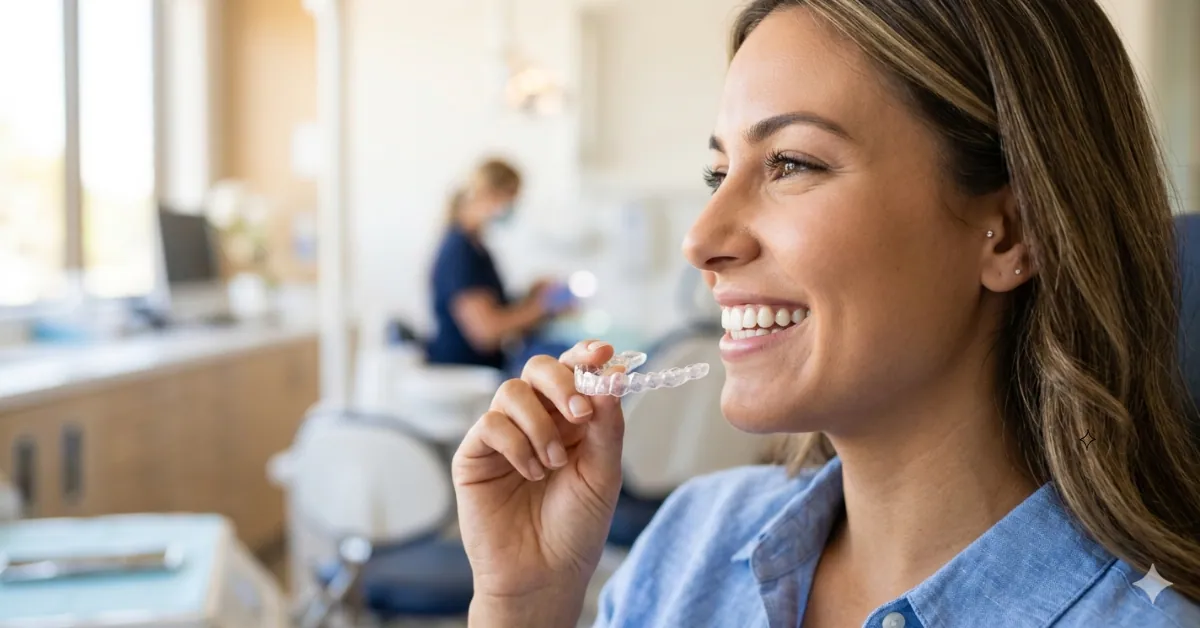
Yes, Invisalign can correct overbites through a carefully engineered process of gradual tooth movement. Each set of custom aligners is designed to shift teeth incrementally toward their target positions. For overbite correction specifically, this typically involves:
- Moving upper front teeth back to reduce how far they protrude over the lower teeth
- Bringing lower teeth forward to improve bite alignment
- Using precision attachments — small tooth-colored buttons bonded to specific teeth — to give aligners better grip for more complex movements
- Elastics (rubber bands) attached between upper and lower aligners when additional force is needed to correct the bite relationship
What Types of Overbites Can Invisalign Treat?
Invisalign is effective across a wide range of overbite severities:
- Mild overbite correction: Highly successful with Invisalign. Short treatment times and predictable results.
- Moderate overbite correction: Invisalign with attachments and elastics is a well-established approach with excellent outcomes.
- Certain severe overbite cases: Invisalign comprehensive can address more complex deep bite situations, though results depend on individual anatomy.
In some cases, traditional braces remain the more appropriate treatment option. This is typically true when the overbite is caused by a skeletal jaw discrepancy rather than tooth position alone. If the upper jaw is significantly further forward than the lower jaw due to bone structure, surgical orthodontic treatment combined with braces may be recommended. Your dentist will assess this during your consultation.
How Does Invisalign Fix an Overbite?
Every Invisalign overbite treatment begins with a digital smile scan a 3D imaging process that captures the precise shape and position of your teeth and bite. Using this data, your LA Dentist creates a fully customized treatment plan with a 3D simulation showing the projected movement of your teeth from start to finish. You can actually see your expected results before treatment begins.
The aligners work by applying targeted pressure to specific teeth at each stage of treatment. For overbite correction, the plan is engineered to move upper teeth into better alignment with lower teeth, gradually improving the vertical and horizontal relationship between the two arches. This systematic approach ensures bite function improves alongside aesthetics.
For overbite cases, attachments and elastics are frequently part of the treatment. Attachments are small, tooth-colored composite shapes bonded onto specific teeth that allow the aligners to apply directional forces that wouldn’t otherwise be possible with smooth plastic alone. Elastics connect upper and lower aligners to help reposition the jaw relationship over time. Both tools are common, effective, and largely invisible to others.
How Long Does Invisalign Take to Fix an Overbite?
The Invisalign timeline for overbite correction varies based on severity:
- Mild overbite: 6–12 months
- Moderate overbite: 12–18 months
- Complex or severe overbite: 18–24 months
These are general estimates. Your Los Angeles Dentist will provide a more precise timeline after reviewing your digital scans and treatment plan.
Factors Affecting Treatment Duration
Several variables influence how long Invisalign takes to fix an overbite:
- Severity of the overbite: Deeper bites require more tooth movement and more time.
- Patient compliance: Wearing aligners 20–22 hours per day is non-negotiable for staying on schedule. Every hour of missed wear time slows progress.
- Age: Younger patients often experience slightly faster tooth movement, though Invisalign is highly effective for adults at any age.
- Oral health: Active gum disease or untreated dental issues must be resolved before or during treatment, which can affect the overall timeline.
Invisalign Overbite Before and After Results
Patients who complete Invisalign overbite treatment consistently report significant improvements in both appearance and function:
- Straighter, more even teeth with better vertical alignment
- Improved bite alignment where upper and lower teeth meet properly
- Enhanced smile aesthetics — one of the most visible and confidence-boosting outcomes of the entire treatment
The smile transformation that occurs from overbite correction is often more dramatic than patients expect, because correcting the bite changes not just tooth position but also the overall profile and appearance of the face.
Functional Benefits
The benefits go well beyond appearance. Correcting an overbite with Invisalign also delivers:
- Easier, more comfortable chewing as the bite functions the way it was designed to
- Reduced tooth wear — overbites cause upper and lower teeth to strike incorrectly, accelerating enamel erosion over time
- Improved jaw comfort and reduced strain on the temporomandibular joint (TMJ)
Invisalign vs Braces for Overbite Correction
Both Invisalign and traditional braces are effective for overbite correction. For mild to moderate cases, Invisalign delivers results comparable to braces. For severe skeletal overbites, braces — sometimes combined with jaw surgery — may be the more effective option.
This is where Invisalign has a clear advantage. Clear aligners are virtually invisible, making them the preferred choice for adults and teens who don’t want the look of metal braces. Invisalign is also more comfortable no sharp brackets or wires irritating the inside of your cheeks.
Treatment times are broadly similar between the two options for comparable cases. Invisalign may be slightly faster for mild cases braces may have an edge for very complex bite issues.
| Factor | Invisalign | Braces |
|---|---|---|
| Visibility | Nearly Invisible | Highly Visible |
| Comfort | High | Moderate |
| Removable | Yes | No |
| Oral Hygiene | Easier | More Difficult |
| Average Cost | $3,000 – $8,000 | $2,500 – $7,000 |
| Insurance Coverage | Yes (if ortho benefits) | Yes |
How Much Does Invisalign Cost for Overbite Treatment?
Invisalign overbite treatment cost varies based on case complexity:
- Mild overbite cases: $3,000 – $4,500
- Moderate overbite cases: $4,500 – $6,000
- Complex overbite cases: $6,000 – $8,000
Does Insurance Cover Invisalign for Overbite? Yes, if your dental plan includes orthodontic benefits, it will typically cover Invisalign for overbite correction at the same rate as braces. Most PPO plans offer a lifetime orthodontic maximum of $1,000 – $2,500, which applies directly to your Invisalign cost. Popular plans including Delta Dental, Aetna, Cigna, and MetLife commonly include these benefits.
Flexible Payment Plans: Most orthodontic offices throughout Los Angeles offer in-house financing with low or zero-interest monthly payment plans. Third-party options like CareCredit also provide 0% interest promotional periods ranging from 6 to 24 months, making treatment accessible regardless of budget. FSA and HSA accounts can also be applied to reduce your effective cost using pre-tax dollars.
Is Invisalign Effective for Adults With Overbites?
Adult Overbite Treatment Success: Absolutely. Adult overbite treatment with Invisalign has a strong track record of success. While bone density in adults is higher than in teenagers meaning tooth movement can be marginally slower — the outcomes are highly predictable and the results are permanent with proper retainer use.
Why More Adults Choose Invisalign: Adults in Los Angeles from professionals in Santa Monica to entrepreneurs in Long Beach overwhelmingly prefer Invisalign over braces for one primary reason: discretion. Clear aligners allow adults to undergo orthodontic treatment without it affecting their professional appearance or social confidence. You can wear them through meetings, presentations, and social events without anyone noticing.
Age and Treatment Outcomes: There is no upper age limit for Invisalign. Patients in their 30s, 40s, 50s and beyond successfully complete overbite treatment with excellent results. The key requirements are healthy teeth and gums, not a specific age.
Signs You’re a Good Candidate for Invisalign Overbite Treatment
Wondering if Invisalign is right for your overbite? Here are the key indicators:
Mild to Moderate Overbite: If your overbite is caused primarily by tooth position rather than skeletal jaw structure, Invisalign is likely a strong option. A consultation with a digital scan will confirm this definitively.
Healthy Teeth and Gums: Active gum disease or significant cavities need to be addressed before orthodontic treatment begins. Patients with a healthy oral foundation are ideal candidates.
Commitment to Wearing Aligners: Invisalign requires discipline. Candidates who can commit to wearing aligners 20–22 hours daily and changing trays on schedule will see the best results.
Desire for a Discreet Orthodontic Solution: If you want effective bite correction without the visibility of metal braces, Invisalign is designed exactly for you.
Why Treating an Overbite Is Important
Many people assume an overbite is purely a cosmetic issue. In reality, leaving an overbite untreated can have significant long-term consequences for your oral health:
Prevent Excessive Tooth Wear: When teeth don’t meet properly, certain teeth absorb more impact than they should. Over years, this leads to enamel erosion and increased sensitivity.
Improve Jaw Function: A corrected bite distributes chewing forces evenly across all teeth and reduces strain on the jaw joints, improving overall comfort and function.
Reduce Risk of TMJ Issues: Overbites are a known contributing factor to temporomandibular joint (TMJ) dysfunction — a condition that causes jaw pain, clicking, headaches, and difficulty opening the mouth fully. Bite correction treatment reduces this risk significantly.
Enhance Smile Confidence: Beyond the clinical benefits, correcting an overbite often produces a dramatic improvement in smile appearance, which has measurable positive effects on confidence and quality of life.
Invisalign Overbite Treatment in Los Angeles
Los Angeles is home to a wide range of skilled orthodontists offering Invisalign for overbite correction. Patients throughout the region — including those in Santa Monica, Pasadena, Long Beach, and across Los Angeles — have access to experienced providers equipped with the latest digital scanning and 3D treatment planning technology.
When choosing a provider, look for a Platinum or Diamond Invisalign Provider designation, which indicates a high volume of successfully completed Invisalign cases and advanced clinical experience.
Benefits of Choosing a Local Invisalign Expert
- Advanced digital smile scans performed in-office for precise treatment planning
- Fully customized treatment plans tailored to your specific overbite and smile goals
- Ongoing monitoring at regular checkups to ensure your bite is correcting on schedule
- Easy access to refinements if additional aligner trays are needed to perfect your results
Frequently Asked Questions
Can Invisalign completely fix an overbite?
For mild and moderate overbites caused by tooth position, yes — Invisalign can completely correct the overbite. Severe skeletal overbites may require additional treatment beyond aligners alone.
Can Invisalign fix severe overbite cases?
Some severe overbites can be addressed with Invisalign Comprehensive, particularly deep bites. However, overbites caused by significant jaw misalignment may require braces or surgical orthodontic treatment. Your orthodontist will advise after your assessment.
How long does Invisalign take for overbite correction?
Mild cases typically take 6–12 months, moderate cases 12–18 months, and complex cases 18–24 months.
Is Invisalign better than braces for overbite treatment?
For mild to moderate overbites, Invisalign delivers comparable results to braces with added benefits of discretion, comfort, and easier oral hygiene. For severe skeletal cases, braces may be more effective.
How much does Invisalign cost for overbite treatment?
Costs range from $3,000 for mild cases to $8,000 for complex overbite correction. Insurance orthodontic benefits typically reduce this by $1,000 – $2,500.
Will Invisalign improve my bite permanently?
Yes — with consistent retainer use after treatment, your corrected bite will be maintained long term. Retainers prevent teeth from shifting back to their original positions.
Conclusion
So, can Invisalign fix an overbite? For most patients, the answer is yes. Invisalign is a proven and effective treatment for correcting mild to complex overbites while improving both bite function and smile appearance. With advancements in clear aligner technology and expert treatment planning, many patients can achieve lasting results without traditional braces. If you’re considering treatment, schedule a consultation with an experienced Invisalign dentist in Los Angeles to receive a personalized assessment and discover the best path to a healthier, more confident smile.