How Much Does Invisalign Cost in Los Angeles?
June 23, 2026
If you’ve been thinking about straightening your teeth, chances are cost was one of your first questions. Invisalign has become one of the most sought-after orthodontic treatments in Los Angeles and for good reason.
The clear aligner system offers a discreet, comfortable alternative to traditional metal braces. But before you book a consultation, it helps to understand what you’re likely to pay, what drives those numbers, and how to make treatment more affordable.
This guide breaks down everything you need to know about Invisalign pricing in Los Angeles, including average costs, insurance coverage, financing options, and the hidden expenses most patients don’t think about until they’re already in treatment.
What Is the Average Invisalign Cost in Los Angeles?
Invisalign treatment in Los Angeles typically ranges from $3,000 to $8,500, depending on the complexity of your case and the provider you choose. That’s a wide range, and it reflects just how different one patient’s needs can be from another’s.
Here’s a general breakdown by treatment type:
- Invisalign Lite (mild cases): $3,000 – $4,500
- Invisalign Moderate: $4,500 – $6,000
- Invisalign Comprehensive (complex cases): $6,000 – $8,500+
These figures typically include your initial consultation, digital 3D scans, all aligner trays for your treatment, progress check visits, and in many cases, one set of retainers at the end. However, what’s included varies by provider, so it’s always worth asking exactly what your quote covers before signing anything.
Los Angeles is a competitive market for cosmetic and orthodontic dentistry. That works in your favor — providers are motivated to offer fair pricing and modern technology to attract patients. However, practices in premium neighborhoods like Beverly Hills or West Hollywood may price higher than those along Wilshire Boulevard or in areas like Hancock Park and Miracle Mile.
What Factors Affect Invisalign Cost?
No two Invisalign treatments are priced exactly the same. Here are the main variables that influence what you’ll pay.
Treatment Complexity
This is the single biggest cost driver. A patient with mild crowding or a small gap between two teeth will need far fewer aligners and a shorter treatment timeline than someone dealing with significant bite misalignment or severe crowding across multiple teeth. More complexity means more planning, more trays, and more of the provider’s time.
Number of Aligners Needed
Invisalign works in stages. Each tray moves your teeth a small amount, and you progress through a series until you reach your final result. Mild cases might require 10 to 20 trays. Comprehensive treatment can involve 40 or more. More aligners mean higher lab costs, which get passed on in your quote.
Length of Treatment
Short-term treatments (6 months or less) cost less than extended treatment plans running 18 to 24 months. Longer timelines mean more aligner sets, more follow-up appointments, and more provider involvement overall.
Dentist or Orthodontist Experience
Providers who are Invisalign Platinum or Diamond level — designations based on how many cases they’ve completed — often charge more than less-experienced providers. In most cases, the premium is justified: experienced providers are more skilled at treatment planning, handle complex cases better, and are less likely to require mid-course corrections that add time and cost.
Technology Used
Practices that invest in advanced technology — like iTero digital scanners, 3D treatment planning software, and in-office monitoring tools — may charge slightly more, but these tools improve accuracy, reduce the need for refinements, and lead to better outcomes. Think of it as paying for precision.
Invisalign Cost for Mild, Moderate, and Complex Cases
Mild Cases
Mild cases involve minor cosmetic concerns: a slightly crooked front tooth, small gaps, or minimal crowding that doesn’t affect bite function. These are often treated with Invisalign Lite and require fewer trays over a shorter time frame — usually 6 to 12 months. Cost in Los Angeles for mild cases typically falls between $3,000 and $4,500.
Moderate Cases
Moderate cases involve more noticeable spacing issues, moderate crowding affecting several teeth, or minor bite irregularities. Treatment typically lasts 12 to 18 months. Pricing in this range generally runs $4,500 to $6,000 in the LA market.
Complex Cases
Complex cases include significant crowding, large gaps, crossbites, underbites, or overbites that require extensive tooth movement. Patients with bite issues often require longer treatment plans and may need additional accessories like attachments or interproximal reduction.
If you’re wondering whether clear aligners can address bite concerns, Invisalign has advanced considerably in recent years and can handle many bite correction scenarios that previously required braces. Your provider will assess whether your specific bite issue falls within Invisalign’s range of treatment.
Complex case pricing in Los Angeles typically starts around $6,000 and can reach $8,500 or more.
How Much Does Invisalign Cost With Insurance?
The good news: many dental insurance plans help offset Invisalign costs. The less-good news: coverage varies significantly by plan, and the details matter.
Most PPO dental plans that include orthodontic benefits will contribute toward Invisalign the same way they’d contribute toward traditional braces. Common coverage amounts range from $1,000 to $2,500 per lifetime, applied once to orthodontic treatment. Some plans cover a percentage (typically 50%) up to an annual or lifetime maximum.
Key things to check with your insurance provider:
- Does your plan include orthodontic benefits at all? (Not all do.)
- What is the lifetime orthodontic maximum?
- Is there an age limit? Some plans only cover orthodontia for patients under 18 or 19.
- Is Invisalign specifically listed as a covered treatment, or does your plan cover “clear aligners”?
- Has your orthodontic benefit already been used on previous treatment?
Insurance can dramatically reduce your out-of-pocket expenses — sometimes by a third or more. Many Invisalign providers in Los Angeles have in-house insurance coordinators who can verify your benefits before you start, so you know exactly what you’ll owe.
Invisalign vs. Braces Cost in Los Angeles
Traditional metal braces in Los Angeles typically cost between $3,000 and $7,000, putting them in a similar range to Invisalign for many patients. Ceramic (tooth-colored) braces tend to cost slightly more — $4,000 to $8,000 — and approach Invisalign pricing territory.
When comparing the two, cost alone doesn’t tell the whole story:
| Factor | Invisalign | Traditional Braces |
|---|---|---|
| Appearance | Nearly invisible | Visible metal brackets |
| Removability | Removable for eating/brushing | Fixed for entire treatment |
| Comfort | Smooth plastic trays | Metal brackets and wires |
| Oral hygiene | Easier — no brackets | More challenging |
| Diet restrictions | None | Many (no hard/sticky foods) |
| Office visits | Less frequent | Every 4–6 weeks for adjustments |
For many Los Angeles patients, the lifestyle benefits of Invisalign — especially the ability to remove aligners for meals, photos, and special events — justify any cost difference. For complex cases, traditional braces may still be the more effective choice. Your provider is the best person to advise which option gives you the best result for your specific situation.
Are Invisalign Payment Plans Available?
Paying $5,000 to $7,000 out of pocket isn’t realistic for most people and you don’t have to. Several financing options make Invisalign accessible at manageable monthly payments.
In-House Payment Plans: Many Los Angeles dental practices offer their own interest-free installment plans, typically requiring a down payment followed by monthly payments spread over the length of treatment.
CareCredit: This is a healthcare-specific credit card accepted at many dental offices. CareCredit offers promotional periods with 0% interest if the balance is paid in full within the promotional window (typically 6, 12, or 18 months). After that window, deferred interest may apply — read the terms carefully.
Lending Programs: Third-party services like Lending Club Patient Solutions or Sunbit offer fixed monthly payments over 12 to 60 months with set interest rates. These work more like personal loans and can be a good option if you want predictable payments without promotional-period pressure.
HSA and FSA Accounts: Invisalign qualifies as a medical expense under both Health Savings Accounts and Flexible Spending Accounts. If you have either, you can use pre-tax dollars to pay for treatment — effectively reducing the cost by whatever your marginal tax rate is.
Ask your provider upfront about all financing options available. Most practices want to help patients find a payment structure that works, and being direct about your budget allows them to help you plan accordingly.
Is Invisalign Worth the Cost?
Cost is a valid concern, but it’s worth stepping back and considering what you’re actually getting.
Aesthetic benefits are the most obvious: Invisalign aligners are nearly invisible, meaning most people will never know you’re in treatment. For working professionals, adults in social settings, or anyone camera-shy about a mouth full of metal, this matters.
Convenience is significant. Because aligners are removable, there are no dietary restrictions, no complex brushing-around-brackets routines, and no last-minute appointment scrambles when a wire pops. You take them out, eat what you want, brush normally, and put them back in.
Oral health outcomes are often better too. Properly aligned teeth are easier to clean, which reduces the risk of cavities, gum disease, and uneven wear over time. Investing in alignment now can prevent more costly dental work later.
Confidence is hard to quantify but very real. Patients who complete Invisalign treatment consistently report improvements not just in their smiles, but in how often they smile, how they feel in photos, and how they present themselves professionally and socially.
Hidden Costs Patients Should Know About
A few expenses can catch patients off guard if they’re not aware of them in advance.
Lost or damaged aligners require replacement trays, which typically cost $150 to $300 per tray. Losing trays repeatedly can add up quickly.
Retainers are a lifelong commitment after orthodontic treatment. Most Invisalign packages include one set of retainers, but you’ll eventually need replacements — typically every 1 to 3 years depending on the type. Budget $200 to $500 per set.
Refinements are additional aligner sets ordered mid-treatment if your teeth aren’t tracking as planned or if your goals change. Some providers include one round of refinements in their base price; others charge separately. Ask before you start.
Missed appointments can occasionally result in fees at some practices, and prolonged gaps between visits can disrupt treatment progress.
How to Protect Your Invisalign Investment
Once you’re in treatment, small habits make a big difference in staying on track and on budget.
Wear your aligners consistently. Invisalign only works when it’s in your mouth. The standard recommendation is 20 to 22 hours per day. Cutting corners by removing trays too frequently slows progress and can require additional aligner sets.
Attend all follow-up visits. Progress check appointments exist to catch issues early. Skipping them means problems go unnoticed longer and can compound.
Maintain excellent oral hygiene. Brushing after every meal before reinserting aligners prevents staining and reduces the risk of cavities forming under trapped food particles.
Clean your aligners properly. Rinse them with cool water every time you remove them, and clean them with a soft toothbrush and mild soap or Invisalign cleaning crystals daily. Avoid hot water, which can warp the plastic, and avoid colored soaps or mouthwashes that can tint the trays.
Does Invisalign Hurt?
Most patients experience mild pressure or tightness when they switch to a new set of aligners — usually every 7 to 14 days. This sensation is a sign the aligners are working. For most people, it fades within 24 to 48 hours.
Invisalign discomfort is generally described as less intense than the soreness some patients experience after braces adjustments. Over-the-counter pain relievers like ibuprofen can help during the first day or two of a new tray. Discomfort does not indicate a problem with your treatment and does not affect the overall cost of your care.
How to Get an Accurate Invisalign Cost Estimate
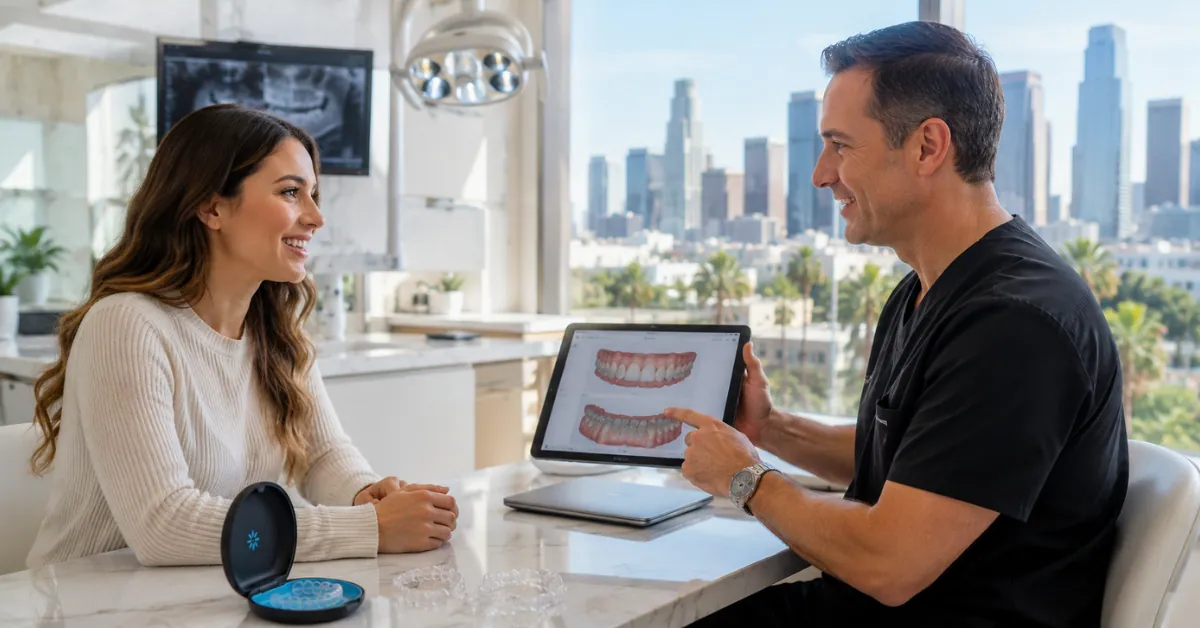
The only way to know what your treatment will actually cost is to schedule a consultation. A qualified Invisalign dentist in Los Angeles will take digital scans of your teeth, assess the complexity of your case, review your insurance benefits, and provide a customized treatment plan with clear pricing.
Most consultations in the LA area are complimentary — there’s no cost to get an expert opinion and an accurate number. Once you have that information, you can compare options, explore financing, and make a decision based on your actual situation rather than general ranges.
Practices throughout Los Angeles — including those in Beverly Hills, West Hollywood, Miracle Mile, Hancock Park, and along Wilshire Boulevard — offer Invisalign consultations, so access is rarely a barrier regardless of where you live or work in the city.
Frequently Asked Questions
How much does Invisalign cost in Los Angeles?
Most cases fall between $3,000 and $8,500 depending on treatment complexity, provider experience, and what’s included in the package.
Is Invisalign more expensive than braces?
Not necessarily. Both options cover a similar price range. Invisalign may cost slightly more in some cases, but the lifestyle benefits often make it the preferred choice.
Does insurance cover Invisalign?
Many PPO dental plans with orthodontic benefits contribute $1,000 to $2,500 toward Invisalign. Coverage varies by plan, so verify your benefits before starting treatment.
Are monthly payment plans available?
Yes. Most providers offer in-house financing, and third-party options like CareCredit and HSA/FSA accounts are widely accepted.
How long does Invisalign treatment take?
Mild cases can complete in 6 months. Comprehensive treatment typically takes 12 to 24 months.
Can Invisalign fix overbite problems?
Invisalign can address many bite issues, including mild to moderate overbites. Your provider will determine whether your specific case falls within the treatable range.
What happens if I lose an aligner
Contact your provider right away. You’ll likely wear the previous tray while a replacement is ordered. Replacement trays typically cost $150 to $300.
Is Invisalign worth the investment?
For most patients, yes — especially when you factor in the aesthetic, convenience, and long-term oral health benefits. The key is choosing an experienced provider and committing to consistent wear.
Conclusion
Invisalign costs in Los Angeles vary widely, but with the right information, the investment becomes much easier to evaluate. Treatment complexity, provider experience, insurance benefits, and financing options all play a role in what you’ll ultimately pay — and what you’ll ultimately save.
The bottom line is this: price matters, but it’s not the only thing that matters. An experienced provider, a well-designed treatment plan, and a financing structure that fits your budget will serve you far better than simply finding the lowest quote in the city.
If you’re considering Invisalign in Los Angeles, CA, the best next step is a personalized consultation. An experienced Invisalign dentist in Los Angeles can evaluate your smile, clarify your insurance benefits, review all available financing options, and build a treatment plan tailored to your goals — so you can move forward with confidence, clarity, and a clear picture of what your new smile will cost.